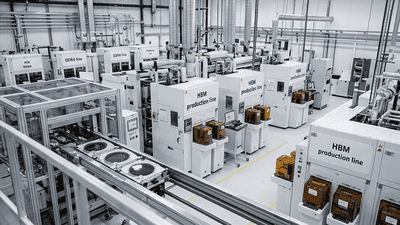
High‑Bandwidth Memory (HBM) is now a critical component across AI training clusters, inference accelerators, and high‑performance computing systems. As demand surged between 2022 and 2026, suppliers scrambled to expand wafer capacity, interposer production, advanced packaging, and specialized test and burn‑in capacity. Yet multiple bottlenecks—packaging throughput, materials, tooling lead times, and yield learning—left the market short of fully meeting demand.

Executive summary
- Estimated 2026 shortfall (global finished HBM modules): 12–22% under the Base Demand scenario, concentrated in high‑stack, high‑performance HBM3e/HBM4 tier products.
- Primary bottlenecks: advanced packaging (hybrid bonding and interposer availability), test and burn‑in capacity, yield ramp speed for new die/process nodes, and shortages in critical auxiliary materials (GMC/EMC and specialty films).
- Geographic and product segmentation: Shortfalls are most acute for qualified, high‑stack-count HBM modules destined for hyperscalers and leading accelerator OEMs; lower‑stack HBM2E and commodity high‑density DRAM derivatives faced comparatively smaller gaps.
- Timing to close gap: Under moderate capex and yield improvement assumptions, the market could approach balance by late 2027–mid‑2028 for mid-stack HBM, while parity for highest‑end HBM4 may not be achieved until 2029–2030 without accelerated packaging capacity expansion or major yield breakthroughs.
- Short‑term mitigation: Suppliers can narrow shortages by optimizing yield learning, prioritizing allocation to high‑value customers, increasing burn‑in parallelism, qualifying alternative materials, and raising safety stocks—each with trade‑offs in cost and time.
How we define the gap

For clarity, this analysis defines the HBM supply‑demand gap as the shortfall in finished, qualified HBM modules available to the market in 2026 compared with expected demand from hyperscalers, OEMs, and other major buyers under a Base Demand forecast. The gap is measured in finished modules (or in wafer‑equivalent adjusted for stack counts) because wafer starts alone are insufficient—packaging, testing, and qualification determine usable supply.
Key inputs to the forecast include reported and inferred wafer‑start plans from major memory makers; announced packaging/OSAT capex and delivery timelines; estimated conversion ratios from wafer‑equivalents to finished modules by stack class; typical yield learning curves for new HBM nodes; and auxiliary constraints (materials, tooling, test capacity). Where public disclosures are incomplete, conservative industry proxies and historical ramp behavior inform estimates.
Base estimate for 2026 shortfall
Under the Base Demand scenario—assuming strong hyperscaler procurement, continued growth in AI infrastructure investment, and no major policy disruptions—our consolidated estimate for the global shortfall of finished, qualified HBM modules in 2026 is:
- Absolute shortfall: approximately 18–28 million finished modules (illustrative; depends on module size and stack mix).
- Percentage shortfall: roughly 12–22% of forecasted 2026 demand for finished HBM modules.
Important nuance: Percent shortfalls are larger in the highest‑end product tiers. For example:
- High‑stack HBM3e/HBM4 pilot modules (highest performance): estimated shortfall 25–45% due to packaging and yield constraints.
- Mid‑stack HBM3/HBM3e mainstream modules: estimated shortfall 10–18%, improving faster as packaging lines scale and yields climb.
- Low‑stack HBM2E or commodity stacked DRAM derivatives: estimated shortfall 0–8%, constrained mainly by wafer allocation rather than packaging.
Where the gap comes from: bottlenecks and drivers

The HBM supply chain is multi‑stage; deficits often occur downstream of wafer production. The main drivers in 2026 were:
- Packaging throughput and OSAT capacity: Hybrid bonding, fine‑pitch alignment, interposer shortages, and CoWoS‑style assembly lines have long lead times (18–36 months) and required specialized tooling. Many OSATs ran at high utilization with significant backlogs, limiting finished module output even when wafer supply was available.
- Yield learning on new dies and process nodes: Early HBM3e/HBM4 pilots experienced lower effective yields per wafer due to bonding defects, TSV/stitching issues, and materials sensitivity—reducing usable finished modules per wafer‑equivalent.
- Test and burn‑in capacity: HBM requires longer, more complex test flows and burn‑in; installed test and burn‑in tooling grew fast but lagged module throughput requirements, creating a testing bottleneck for qualification and shipping.
- Auxiliary materials shortages: GMC and EMC tightness, specialized underfills, TIM films, and low‑defect interposer silicon constrained certain processes or required slower cycles when substitutes were used—raising scrap and rework.
- Tool lead‑times and equipment export constraints: Advanced ALD, hybrid‑bond equipment, and high‑precision metrology tools had constrained supply partly due to export controls and partly due to long OEM delivery queues.
- Allocation choices and long‑term contracts: Major hyperscalers and OEMs that prepaid or co‑invested captured early allocations, leaving non‑strategic buyers exposed to spot shortages—this concentrated the measurable shortfall for smaller buyers more than for the market as a whole.
Regional and product segmentation of shortages
Shortfalls were not uniform across regions or product tiers:
- Geographic concentration: South Korea, Taiwan, and selected U.S. sites hosted most advanced packaging capacity; any local disruption or constrained expansion plans disproportionately affected global supply. Regions reliant on imports (e.g., some parts of Europe) faced larger spot premiums and allocation volatility.
- Product segmentation: Highest‑value HBM3e and pilot HBM4 modules faced the largest shortages. Mid‑stack HBM3 was constrained but scaled more quickly because tooling and yield lessons transferred from earlier generations.
- Customer concentration: Anchor customers (hyperscalers, national labs, defense programs) received preferential allocation—meaning the apparent market shortfall for general availability modules was larger than the headline supply gap when contract allocation is considered.
Scenario analysis: downside and upside cases

Supply‑demand dynamics are path dependent. Below are three scenarios that show potential trajectories beyond 2026.
Downside (Worse) scenario: 25–35% shortfall persists through 2027
- Assumptions: Yield ramps stall for HBM3e and HBM4 pilots; packaging capacity expansion delays (equipment lead times elongate due to export controls and OEM backlogs); material shortages intensify seasonally or via trade measures.
- Outcomes: Strong spot premiums, rationing to strategic customers, extended lead times, persistent pressure on system integrators, and potential delays to large AI fleet rollouts. Suppliers capture elevated ASPs but face customer friction and political scrutiny.
Base scenario: gap narrows to 5–10% by late 2027
- Assumptions: OSATs and equipment vendors deliver scheduled capacity expansions; yield learning accelerates due to process‑transfer across sites and improved material consistency; test and burn‑in installed base increases per forecast.
- Outcomes: Mid‑stack product availability improves rapidly; pricing normalizes gradually for mainstream HBM modules; high‑end HBM4 transitions from pilot scarcity to constrained volume by 2028.
Upside (Faster closure) scenario: gap eliminated by mid‑2027
- Assumptions: Rapid tool deliveries, successful parallelization of burn‑in and test flows, aggressive co‑investment by hyperscalers to accelerate OSAT expansions, and rapid qualification of alternative materials that remove constraints.
- Outcomes: Short‑term spot premiums collapse, contracted pricing renegotiations moderate, and suppliers face near‑term revenue rebalancing as ASP compression accelerates.
Quantitative sensitivity: what moves the needle most?
Three levers most strongly affect closed‑loop supply in 2026–2027:
- Packaging throughput increases (hybrid‑bond/CoWoS capacity): A 20% increase in packaging capacity can reduce the finished‑module shortfall by roughly 8–12% in the near term because packaging is a downstream bottleneck.
- Yield improvement slope: Accelerating yield learning to shave 6–10 months off the effective yield ramp for HBM3e reduces effective shortfall by ~5–10% because more wafers convert to shippable modules sooner.
- Test and burn‑in parallelism: Raising burn‑in socket parallelism and reducing per‑module tester hours by 30% lowers the testing bottleneck impact and can reduce overall shortfall by 3–7% depending on the module mix.
Practical mitigations for stakeholders
For buyers (hyperscalers, OEMs)
- Secure long‑term contracts with allocation clauses and priority windows. Prepayments or co‑investment can buy priority access during tight windows.
- Design system flexibility—support multiple memory module classes and tiered performance—to reduce exposure to highest‑end module scarcity.
- Manage rollout phasing—prioritize early deployments where performance gains are most valuable and postpone non‑critical expansions until supply improves.
For memory makers and OSATs
- Accelerate yield learning via cross‑site data sharing, golden‑lot testing, and stronger co‑development with material suppliers to reduce rework and improve first‑pass yields.
- Invest in test parallelism and burn‑in capacity early; qualify automated multi‑socket racks and develop shared test farms where feasible.
- Qualify alternative GMC and EMC suppliers or co‑fund capacity expansions with strategic material vendors to reduce single‑source risk and shorten lead times.
For equipment vendors
- Prioritize deliveries to packaging and test segments; offer modular upgrade paths that allow OSATs to increase throughput quickly without full retooling.
- Provide domain‑specific service contracts and fast spares to minimize downtime for critical hybrid‑bond and high‑throughput testers.
For policymakers
- Facilitate expedited permitting and incentives for regional packaging and materials capacity to lower geographic concentration risk.
- Support workforce development and export‑control dialogues that balance security concerns against tool and material flow essential for global supply.
Market and pricing implications
Persistent shortfalls through 2026 produced clear market effects:
- Higher ASPs and spot premiums for constrained high‑end modules, particularly where qualification and allocation mattered.
- Increased bargaining power for suppliers with packaging and test capacity, enabling tiered pricing and prioritized allocation for strategic customers.
- Investment signals to equipment and material suppliers, accelerating orders for hybrid‑bond tools, high‑parallelism burn‑in racks, and high‑purity materials.
As the gap narrows, expect ASP compression, but also a rebalancing in margins as suppliers either capture more service revenue (integration, qualification) or see module ASPs decline.
Leading indicators to watch (next 6–12 months)
- OSAT lead times and utilization reports—rising lead times indicate ongoing packaging constraints.
- Equipment vendor backlogs for hybrid‑bond and high‑bandwidth ATE—longer queues signal multi‑quarter tightness.
- Yield improvement announcements and pilot yield curves from major memory makers—faster slopes reduce shortfalls.
- Material supplier production expansions and qualification notices—additional GMC/EMC capacity eases auxiliary constraints.
- Contract announcements and prepayment deals from hyperscalers—continued co‑investment suggests allocation will remain prioritized rather than broadly available.
Actionable checklist for the next 90 days
- Buyers: Review and, if necessary, renegotiate contracts to include allocation and force‑majeure clarity. Lock critical program volumes as early as feasible.
- Memory makers/OSATs: Audit test and burn‑in throughput; implement immediate process improvements to reduce per‑module test time (even if at higher per‑unit cost short term).
- Equipment suppliers: Publish realistic lead‑time windows and offer staged delivery or lease options to OSATs to accelerate throughput deployment.
- Materials teams: Initiate parallel qualification programs for highest‑risk GMC/EMC items and coordinate with procurement on safety‑stock policy.
Conclusion
The 2026 HBM shortfall—estimated at roughly 12–22% of finished module demand under a Base scenario—reflects the complex reality that finished supply depends on more than wafer starts. Packaging, test, yield learning, and materials are the operational levers that determine usable output. While mid‑stack HBM shortages should ease by late 2027 under plausible capacity and yield assumptions, the highest‑end HBM4 tier will remain capacity‑constrained without accelerated packaging expansion, yield breakthroughs, or significant co‑investment by hyperscalers and OEMs. Strategic actions—long‑term contracts, co‑investment in packaging/test capacity, rapid yield learning, and diversified material qualification—can materially reduce the shortfall and its economic pain. Stakeholders who act now to secure allocation and reduce downstream bottlenecks will avoid the worst impacts of 2026’s scarcity and be better positioned for the next HBM growth wave.